The Tape, the Pen, and the Camera
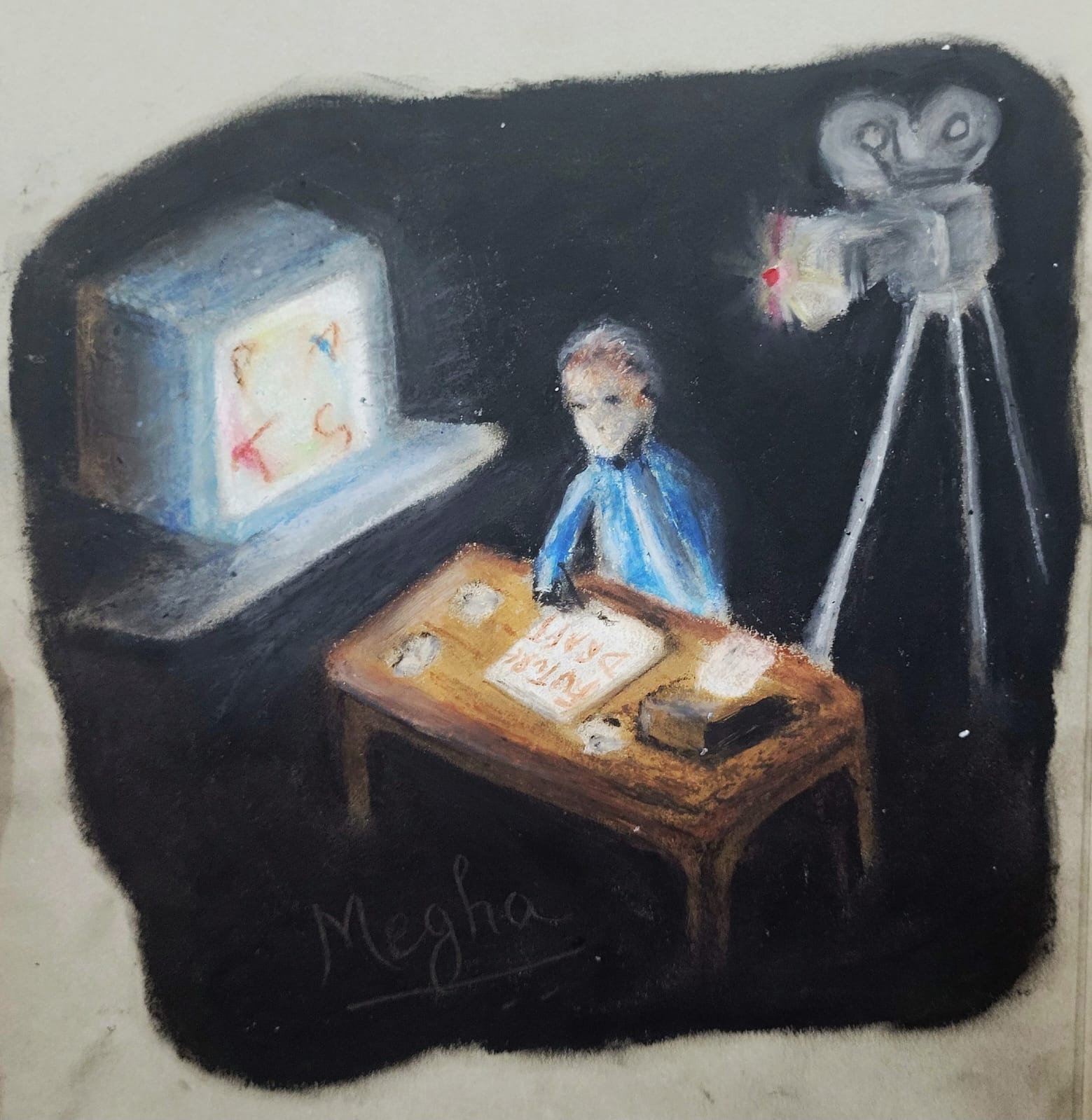
There is one of my doodles I keep coming back to whenever I try to make sense of time. Not the time in the ticking, measurable sense, but time as a lens of how we move through life. There, a person sits at a desk in a poorly lit room. On the left, a screen hums with footage that flickers slightly at the edges, the kind you cannot turn off even if you wanted to. A camera on a tripod stands quietly in the corner, its lens set on the person at the desk who is writing something keenly.
The screen shows the past.
What plays on it cannot be changed - not truly, not at its root. You can rewind it, sit with a moment longer than you did the first time, let it wash over you differently now that you are older or wiser or simply more tired. You can study the decisions you made and what happened. But you cannot reach into the screen and alter what it shows. The tape is already recorded. It exists now as something you are a witness to, not something you are inside.
Personally, this imagery has often turned out to be a more useful way of looking at time. Don’t dwell on the past, people say. Learn from it and move on. But that always felt too easy, too unfinished. A more honest thing would perhaps be that you are the audience of the past, whether you have made peace with that or not. Not the director who could have called for a better take. Not the editor with the luxury of a cut. You are in the seat, watching what already happened. And from that seat, the only real thing you can do is take notes.
The notes, the actions, the writing - that is the present.
What you are putting down on the page in this very moment is quietly informed by what you have been watching. The past bleeds in, as it should. But the writing itself is happening now, in real time, under your hand, shaped by your attention and the particular mood of this hour. It is not the screen. The footage carries what it carries, and the page receives what it receives - and while these two things are in conversation, they are not the same thing. You are not simply transcribing the past. You are responding to it, filtering it, sometimes writing despite it entirely.
The present is the only place where anything actually happens. You are not watching the tape while waiting for it to change nor are you writing the definitive version of a perpetual piece. You are simply writing and that is enough. There is a quiet relief in that, once you let it in - the present does not need to carry the weight of everything before or after it.
And the camera? The camera is capturing the present, which you will watch later.
But you are not the cinematographer. You do not control what the camera sees, who else drifts into the frame, where the light decides to land or what the reel becomes. You can point it toward something. You can decide what to let out into the room, build things that matter to you, send your words and choices out. But you are, in the end, only a co-author of what the footage becomes.
This is not a nihilistic model. Co-authorship is real authorship. To contribute genuinely, to leave a mark that bends the story even slightly, is no trivial act. The choices you make today may ripple somewhere you will never see. But you are not the only one writing this, and the final shape of it is not yours to know or own.
Regret makes sense if you believe you were the director of a scene you could have reshot. Anxiety about the future makes sense if you believe you are the sole author of the future rather than something that is actually being written by many hands, including ones that belong to chance and other people’s choices entirely. And disappointment - perhaps the heaviest of them - only makes sense if you believed the outcome was ever fully yours to control. But you were only ever a co-author. All these assumptions start to crumble when we dare to unveil the reality buried deep within our awareness.
The past is not a verdict. It is a recording - something that happened, something you can learn from yet something that does not need to define what you write next. The future is not a destination you will arrive at alone; it is being written collaboratively, constantly, by more forces than you will ever be able to count. And the present - the desk, the pen, the page in front of you - is the only place where anything can actually be done.
You are the observer of the past. You are the present. You are a co-author of the future.
The things that feel unbearably heavy start getting lighter, once you know which role is actually yours to play.